EUV Insight: thin-film design in the browser
I built EUV Insight for optics engineers designing EUV thin films and multilayer optics. It calculates transmission, reflectance and absorption for a layer stack, so you can compare material and thickness choices.
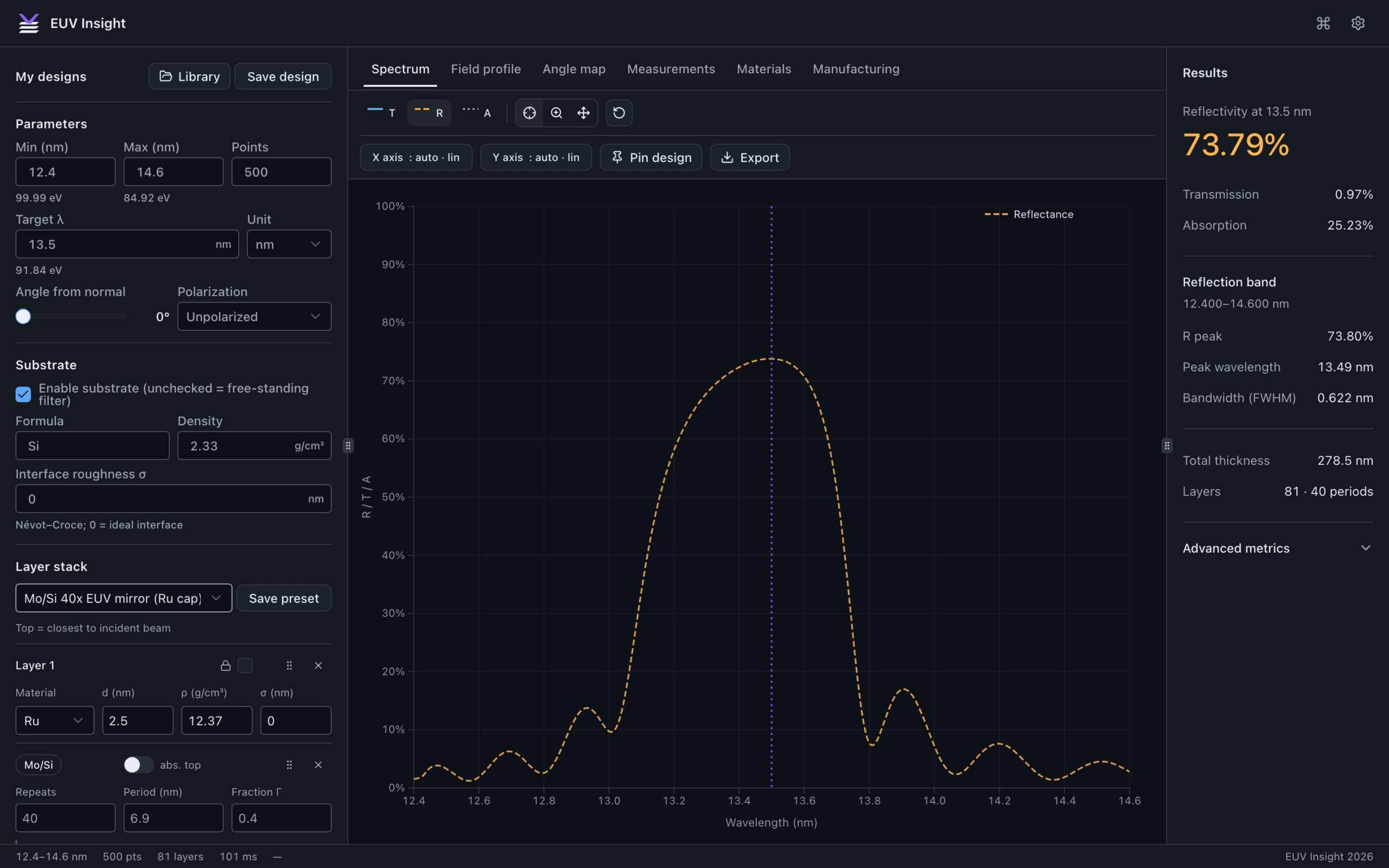
- R peak
- 73.80%
- Peak wavelength
- 13.49nm
- Bandwidth (FWHM)
- 0.622nm
- Total thickness
- 278.5nm
From the results panel in the screenshot above.
From a layer stack to its optical response
Build a filter or multilayer
Choose materials and set their thickness, density and interface roughness. For periodic mirrors, set the number of bilayers, period and absorber fraction.
Examine thickness tolerances
Model independent thickness scatter, shared deposition errors and drift. Monte Carlo runs show a spectrum envelope and a simulated pass rate against the requirements you enter.
Compare and export
Keep earlier designs on the plot while changing the current stack. Export spectra as CSV, figures as SVG or PNG, and a PDF report with the plot, metrics and layer stack. Availability depends on the app’s plan.
The stack in the screenshot: a Ru cap on 40 Mo/Si bilayers, 6.9 nm period, on a Si substrate.
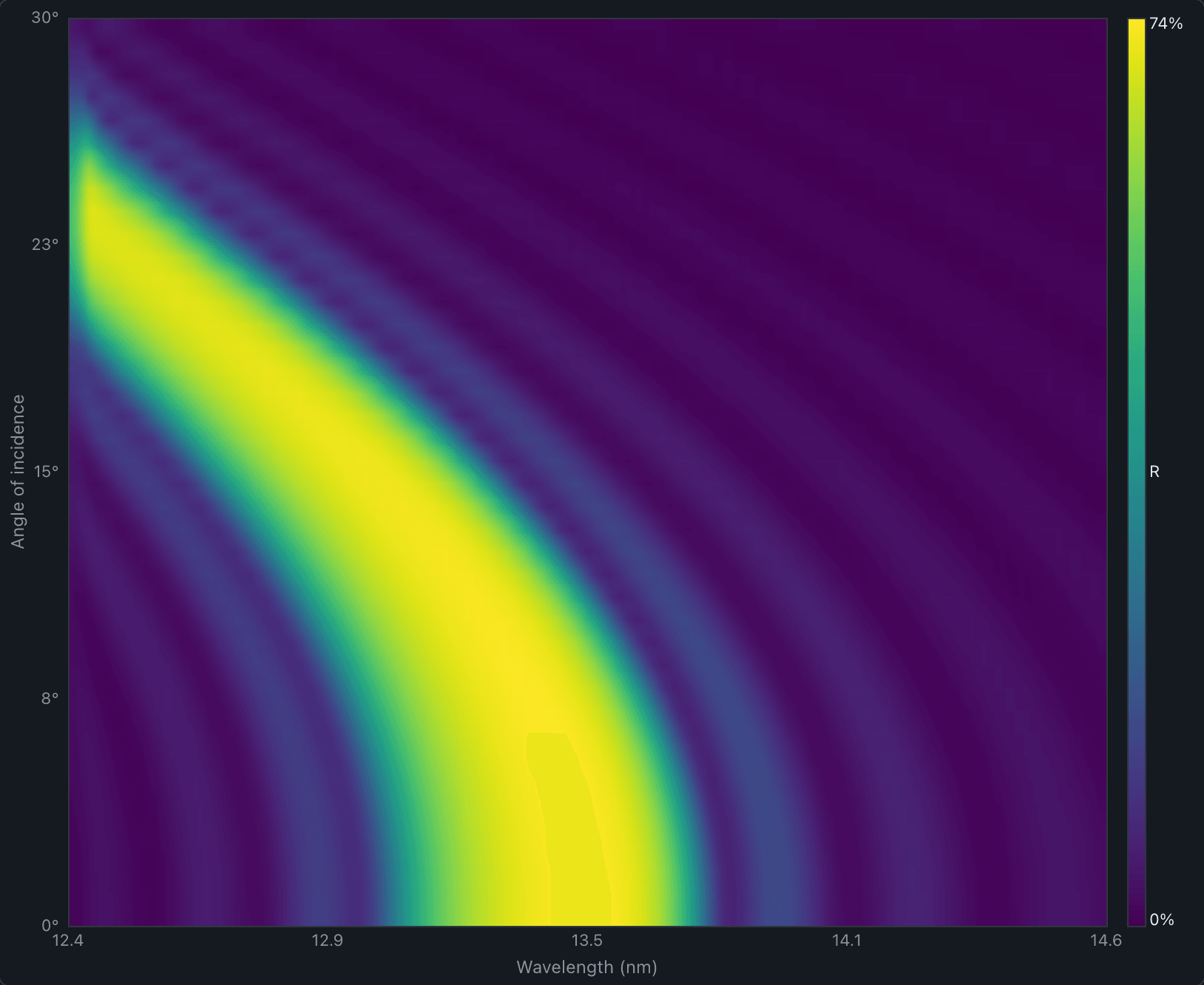
See how the response changes with angle
A wavelength-by-angle map shows where the reflection band moves as the incidence angle changes. You can display reflectance, transmission or absorption and read a value at a chosen wavelength and angle.
The model behind the plots
EUV Insight uses CXRO reference optical constants and a Parratt multilayer calculation, with a Névot–Croce approximation for interface roughness. The results depend on the material data and model assumptions. They are calculated spectra, not measurements of a fabricated coating.
The app’s methods pages describe the calculations, reference data and limitations.
- Optical constants
- CXRO reference data
- Multilayer calculation
- Parratt
- Interface roughness
- Névot–Croce approximation
Need a calculation tool for your products?
Send the design question, the inputs your customers have and the product data available. I’ll review the scope for a browser tool they can use on your website.